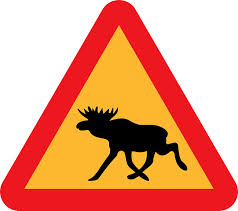
It’s also a time of year when people decide to put giant, handmade, ugly neon signs that read: “VÄRNING! ÄLG!” (“WARNING! MOOSE!”) everywhere.
Elg Norwegian warning sign
In most places in Norway and Sweden there are actual signs that warn of moose – but here in this rural area it is all a DIY effort. The Norwegian signs (the real ones) look like real moose, but the Swedish signs, if you don’t look carefully, look a bit like panthers. Haha. Beware all those wild Swedish panthers.
Swedish älg warning signs
The earlier cited article about Dutch people in Sweden actually made me think of a point that I sometimes question (and it’s not why someone writes the word “assassinate” as “assinate” and posts it on their blog): immigrants (those who have moved completely by choice, like the Dutch woman cited in the article, often report the following feeling: ““In the Netherlands, everyone is always in a hurry. When I went back there recently, I kept thinking: ‘Do you ever take the time to live a little?’.”
This made me wonder whether immigrants (again, by choice) are just by nature more “slowed down” in many cases than those born in a certain place. That is, it is easier to opt out of (or never join in the first place) things that are sort of like family and social obligations that one is often subject to at “home”. My life for example was always full of obligations, greater speed and involvement and integration where I came from – and no matter how I aimed to integrate and ingratiate (haha), I still was kind of “apart”, which naturally slows me down. Did I entirely choose to take the time to live a little or is it a matter more of circumstance because I am not totally integrated and also don’t feel like I have to fit into some preconceived idea about what I have to do and what is expected of me? I hear this “moving abroad helped me take time to live a little” – and immigrants often credit the “slower, more appreciative culture” to which they have moved – but I doubt very much that it is wholly or even appreciably attributable to the adopted country’s culture (in many cases) as much as it is the immigrant’s interpretation and place in that culture.
“You cannot trust me/I will stab you in the back/I’ll sell your grandma on the street to buy some crack/if crack is not available, I’ll buy gelato/you have to take things as they come that is my motto…”
“I have been fucked over a thousand times or two, and now I feel that I must take it out on you…“
Billy Frank Jr – Native American fishing rights activist – died at 83 this week. He had been a guest lecturer in my MPA program many years ago – alongside his late wife, Sue Crystal (d. 2001) — who was one of our faculty members. I did not know either of them well but somehow when these people who played such influential roles in one’s education are gone – it’s certainly a time for reflection. Everyone dies – I know – but despite death’s inevitability, it is natural to reflect on what someone’s place in your life and in the world as a whole meant once they are gone. It’s also a kind of time capsule. I don’t really want to remember my life in 1998-99, but thinking back to Sue Crystal and Billy Frank Jr, it is like I have gone back to that point in time – the hurried, cynical moment when I thought I knew what I wanted and what I was doing – but looking back, I really had no idea.
Billy Frank Jr – RIP
That is kind of an interesting train of thought – thinking you know what you are doing and what you want when in fact you don’t. In my old age I can look back and realize that even though we all think we are well into responsible adulthood by the time we are in our early-to-mid-20s, it feels like we as people were still so unformed and stumbling around when we were 23, 24… which makes it seem all the more shocking to me that people make big life decisions that involve other people (such as marrying and having children) when they are so young themselves. Not that it is wrong by any means – it just seems that life’s wants and needs change so much even between the ages of 22 and 25 and between 25 and 30.
I got the feeling from Sue Crystal’s lectures and her life that she followed a path that she had not intended either. She once mentioned being a Jewish girl from Chicago who became a lawyer. Would she have imagined that her future included marrying a man who fought his entire life for Native American fishing treaty rights in the Pacific Northwest? No, she had not imagined that – but that is exactly where her life took her.
I think a lot about how we blame people for things they said or did in youth – for example, Monica Lewinsky has popped up in the news again lately… and while I don’t know her at all, I can imagine that in her own insecure youth (I have known people whose attention-seeking behavior and need to be noticed led them into situations that were too much to handle and far bigger than they were) she just wanted to feel important, noticed, special and entered into this ill-advised affair with the President of the United States. While Lewinsky has been out of the public eye for a long time, she has never left the public consciousness – and the way she is used as a symbol shifts depending on who is doing the using and why. How is a Republican opponent bringing up at this point how “Lewinsky was used and abused” by Clinton any different from how anyone else has used her, her name and her experience for their own ends? I have no doubt that Lewinsky thought and still thinks that her actions were consensual and were exactly what she wanted. But would they have been what she wanted if she could have foreseen what those actions would lead to – how she would drag their aftermath around with her for the rest of her life?
My point, though, really, is that she was in her early 20s… and even though that is not an excuse, I can look at it and think, “I did a lot of really stupid, regrettable things when I was in my early 20s – asserting that I really thought I was an adult – asserting my ability to make completely independent decisions” – all things that I cringe about now and realize that no actual, grounded adult would do.
We’re developing throughout our lives – and people in their early 20s may in fact be among the most dangerous and vulnerable (particularly to themselves). They are on their own and expected to behave like responsible adults – but are without much guidance or supervision for perhaps the first time in their lives. And when a poor decision is made, it’s said, “S/he should have known better.” But in fact – should they have known better? What previous experience would have prompted them to know better? Sure, maybe it is logical that having sexual relations with a sitting US president is a bad idea, full stop, but what young woman in that situation would do the logical thing – particularly (if I may generalize wildly) the type of attention-seeking woman I perceive Lewinsky to have been?
I digress – all I wanted to say is that sometimes life leads us to places we never imagined.
I do tend to give people the benefit of the doubt when I shouldn’t – and I keep trying to learn that lesson. But I am human and never do. It is just that I try to see the good in people, be compassionate – and then that gets pushed too far, I guess. But at least usually when I close the door, it’s closed – and I don’t regret it. Or the time or the things I have done with/for those people. But just as I cannot control it, I also know when I cannot continue it.
I have realized that almost all people are completely out of control and indecisive – and I have to be the decisive one – or as America’s best-ever president (hahaha) Geo W Bush said, “I am the decider“. Haha. And I need to be the adult, the caretaker – not all people are always going to like that, but regardless of their role, at least the issue is fucking decided and it’s back to the drawing board. No wishy washy BS for weeks, months, years that prevent all parties involved from moving forward and taking responsibility for the things in their lives. That is what making decisions – even incremental ones – enables.
“Goodbye my almost lover/goodbye my hopeless dream/I’m trying not to think about you/can’t you just let me be?/So long my luckless romance/my back is turned on you/shoulda known you’d bring me heartache/almost lovers always do…”
The same actually applies in business. Not that I want to equate the misery of indecision in romantic entanglements with unclear business strategy – but when am I not talking shop? I recently decided to follow an online “basics of marketing” course as kind of a refresher since I work in marketing but was never a marketing student. One of the fundamental points made in creating a strategy is: you can’t do everything, you can’t cater to everyone. Right – this is why we segment and target. But the same principle applies in creating a general business strategy. You can’t really set seven major goals and expect all of them to be met. Choices need to be made and a focus decided. I see this lacking – a lot of talk about strategy and endless meetings about and revisions of strategy but nothing real and tangible that one can bite down on, take a chunk and work toward meaningfully.
At least in a relationship, you can bite down, take a chunk and work toward something if you really want to. But that is a matter of making the choice and focusing too. That’s my conclusion in my old age, sage wisdom and experience – not unlike the great wise, leadership of Captain Stubing on The Love Boat. Hahaha.
A cow in my neck of the woods, western Värmland, Sweden
Lately I have thought and written a lot about farming – or adopting semi-agricultural activity into my life (e.g. getting some hens). I was happy, then, to stumble on an article about a year-old magazine, Modern Farmer, that has rather defied the odds both in being successful (as print media is not really the cutting edge of publishing, is it?) and in being popular – and lauded. I could not be happier about it.
The new age of modern farming perhaps ensures that we will not see the last farmer so soon.
The other day I was doing some “prep cooking” – you know, preparing the stuff that could be done in advance before having a guest in town. And one of the things was this sauce.
Masala:
2 tablespoons vegetable oil
2 cups chopped onion
4 cloves minced garlic
1 1/2 teaspoon garam masala
1 1/2 teaspoon curry
1 1/2 teaspoon ground coriander
1 teaspoon turmeric
1/2 teaspoon cayenne
1 14-ounce can of diced tomatoes
1/2 cup plain, whole-milk yogurt
Heat oil on medium, add onions and saute until lightly golden (about 20 minutes). Add garlic and all the spices. Stir for about a minute. Cool mixture until warm. While mix is cooling, mix the tomatoes and yogurt together and puree until almost smooth. Add the onion-garlic-spice mixture, and again puree until almost smooth.
At this point, the sauce can now be refrigerated for a day or two before using. (This helps develop the flavors.) I left it in the fridge for two days and used it up today. And here’s how to do it…
When ready to prepare…
You can actually use chicken or prawns here. Normally I use prawns, but the guest was not into shellfish and seafood, so I went for chicken.
I cut chicken breasts into bite-sized pieces, cooked them in a separate pan and then transferred them to the pan I prepared for the rest of the process. If using prawns, which cook faster, you can cook them in the same pan as the rest of the process.
Rest of the process:
1 tablespoon vegetable oil
Prepared prawns (or cooked chicken)
Half a can coconut milk (about 7 ounces)
1/4 cup chopped cilantro
1/4 cup green onions, chopped
1 tablespoon lemon juice
Heat oil in a large skillet on medium high. Add the prawns to cook (about 2 minutes). Or add the chicken you have previously cooked. Stir in the coconut milk, cilantro, green onion, lemon juice.
Chicken + coconut milk, lemon + green onions before adding masala
Then add the prepared masala sauce described above. Simmer for about 3 to 5 minutes more.
Chicken masala – final product
Serve with rice (which I like to make with caramelized onions, but that’s just me!).
I remember, entirely without fondness, those nights in childhood when my “friends” and I thought it was a great idea to spend the night at one another’s houses. What could be better than extending the illusion bought during recess and other stolen moments of playing together that we were such great friends that spending 24+ hours together would somehow enhance the “friendship”? My own participation in this ritual and seeming rite of passage was reluctant – at the time I really thought I wanted to do it, and that if I did it, I would somehow grow accustomed to it and how awkward and uncomfortable it always was, particularly for a person like me (shy, quiet, accommodating and always aiming to please – willing to endure hell for the sake of keeping peace). And endure I did. If I once went to someone’s house, I might have been suffering in silent misery, as I often did, but if I had decided I was staying there, I stayed. The only memorable exception to this happened much later, when I was in high school. I had been invited to someone’s overnight birthday party – a girl who was friends with friends, not really my friend directly. My discomfort outweighed my sense of wanting to preserve social harmony; I went home, mostly because it was time to acknowledge that even the friends in that situation were not really my friends.
But one of the strangest scenarios in these overnight adventures were the times when you would get a kid who was like an overeager puppy – so excited to come and stay with you, talking about all the things you would do together when they got there, how you were their best friend ever… and so on. And once they were there, and darkness started to fall, they also whimpered like a little puppy away from its mother for the first time, eventually the whole thing escalating into panic attacks and tears that no one but their mother could calm. This resulted in middle-of-the-night phone calls to their parents, who promptly came to pick them up, saying, “Maybe we can try this again next year when XXXXX is a bit more socially mature.”
I imagined that those kinds of events had ended when I became an adult. Imagine my surprise to find myself in a not entirely dissimilar situation with a full-grown adult who did everything short of calling mommy on the phone to come and get him (and he might have done had his mum been in the same country). I don’t really know how to apply words to this – to describe how jarring this is or how intensely it really takes me back to that awkward place in which I spent so much of my childhood. Really looking at the whole situation, though, all the same pieces were there, and had I not wanted to buy into the illusion now as much as I did when I was a child, I would have seen, understood and never let things reach this stage. I could have set aside the eager-to-make-friends kid I had been and let my inner, overreaching “parent” take over (since, as we know, I have always been a bit of a senior citizen) and be reasonable. Yes, reasonable. I could have seen that it was the same pattern playing out – the eager puppy, full of excited plans, grand words, high and undeserved praise – all empty, really. Not that nothing had been true in the friendship – just that it was applicable in a “limited-time-only” kind of way (not unlike the KFC Double Down sandwich. HA!). That is, when we were “at recess” together or spending time in our fertile imaginations, things were beautiful. But reality is different. Long-term reality is apparently worthy of panic and backpedaling and fearful apologies that cite all the reasons why I should not feel bad, i.e. because it’s “not about X, and it’s not about Y” – but I know, because these are the first and only things mentioned, that it is exactly about and mostly about X and Y.
I am not sure that I have ever been in a weirder situation. I have been in situations that I became a part of because I wanted to believe in them even if I knew it was a foolish idea because I always hope things will be different than reality has taught me. Sometimes someone – a friend on the playground or a casual wanderer through my life’s landscape – will pique my interest enough, show just enough understanding and enthusiasm – that I set aside the doubt and step furtively into the house constructed of walls that some other person built. I did not construct these illusions – I just watched and went along with it because it seemed like such a welcome respite from everything else. Because I wanted to believe maybe the walls they built would somehow, finally, stand – and be solid.
I get something even from the failures (something positive) and reinforcement that I really need to listen only to my instinct and absolutely nothing else – but ultimately the negative outweighs the positive and is always an expensive lesson (both literally and figuratively) – sending me further into the guarded cocoon where I live out most of my days.
Pregnant with mandrakes, or with something else That might prove useful and yet never proves, That never fits a corner or shows use, Or finds its hour upon the loom of days
As usual I don’t know much about or celebrate the Swedish holidays, other than gladly taking the days off they afford – especially now that I am paying attention (I started the year off with a bang – or should I say an alarm – by setting my company’s alarm off just after the new year – had no idea it was a holiday, so I have been careful to take note now).
This weekend we celebrate Valborg (“Walpurgis Night“). For me that means very little except maybe “hello, spring!” and time off. It’s welcome time off really… feel a need for recovery, kickstarting certain endeavors in earnest.
I am usually so dedicated to writing here every day, but if I go off track and don’t for a few days … this is why. Trying to adjust to new endeavors and routines.
I have previously written about the Souk Market in Charlottenberg in Sweden – a tiny town with a whole lot of very large supermarkets, mostly catering to Norwegians who cross the border to buy stuff in bulk. I had not been there in a while, but I planned to make a recipe that required pomegranate molasses (Persian pomegranate and lamb meatball soup).
Considering that I can’t find normal molasses most of the time, the idea that pomegranate molasses could be had (with multiple brand and container-sizer options) in the smallest of towns in rural Sweden seemed laughable. But having been to – and been overwhelmed by – the Souk Market before, I knew it represented my best chance. Imagine my delight when I found an entire section of the store filled with different kinds of molasses, including pomegranate as well as carob and grape, among others. Amazing.
pomegranate molasses from the Souk Market
Check out John Oliver‘s new gig on HBO – in the inaugural episode, he goes on a pomegranate-related tirade.
“Love is not a state of perfect caring. It is an active noun like struggle. To love someone is to strive to accept that person exactly the way he or she is, right here and now.” – Fred Rogers
Mr Fred Rogers on love
It’s no secret that I am a hater. Or at least a surface hater. That is, I am impatient, don’t like crowds, don’t like slow drivers, don’t like the people at the store who block the entire aisle or wait until their huge cartload of groceries is fully checked before getting out their debit card, or people who treat motorway onramps like that is the best possible place for viewing the scenery (i.e., going slow and not accelerating to the speed at which they need to go to merge). I don’t know why I am in such a hurry – but I just can’t fathom why other people are so myopic and inconsiderate – they go slowly (fine) but do so it seems largely because they think they are the only people in the store, on the road, in the world. Thus, I go through life a wee bit irritated, and I cope with this by making my little hate lists, or ranting briefly but not very seriously, about my annoyance. And then it’s done.
(I have never really met anyone who understood this – but when I did, I knew I met my match.)
Apart from this, I tried very hard today to keep things off the hate list. It was the most gorgeous day – warm, sunny, really indicative of why I live here. I had to go out to do a lot of errands, and I am not the biggest fan of Sunday driving in the country, particularly when the weather turns nice, Norwegians come to Sweden in droves – and worse yet, Germans and Dutch will soon arrive. But I kept my cool for the most part. I almost got mad in the grocery store because an old man kept getting in my way. But, despite not interacting with him, I tried to view him in a different light. He seemed to have gone to the store just to get out for a while – and in the end selected carefully and bought himself a bag of loose candy (which all Scandinavians seem to live for). Then he drove himself away at a snail’s pace in an old, original VW Bug. I had passed by the car in the parking lot wondering to whom it belonged (I was parked across the parking lot and had to put my groceries in the car and return my cart and somehow still ended up finishing before this old man got to the car). Once I saw him drive away – slower than slow – it was impossible for me to hate him. He probably owned that car since it was brand new (or at least that is how I like to imagine it). Imagining that he fired up the old car just to go get candy on a Sunday!
This shift in perspective was quite conscious – and although we did not, as I said, interact, acknowledging his humanity made a difference. When I got home, I stumbled on an article that reinforced the same underlying themes. We all follow unspoken social rules and don’t generally make eye contact or strike up conversations with strangers – and I must say unequivocally that this is almost an absolute in Sweden. This article, however, examines some evidence gathered by behavioral scientists who contend that interactions with strangers improve our mood – maybe first by forcing us into a “pretend friendly” mode – but usually by the end of the encounter, the pleasantries and positive interaction has created genuine positive feelings.
“One of the perks of being a behavioral scientist is that when your partner does something annoying, you can bring dozens of couples into the laboratory and get to the bottom of it. When Liz tested her hypothesis in a lab experiment, she discovered that most people showed the “Benjamin Effect”: They acted more cheerful around someone they had just met than around their own romantic partner, leaving them happier than they expected.
Many of us assume, however, that our well-being depends on our closest ties, and not on the minor characters in our daily lives. To investigate the validity of this assumption, our student Gillian M. Sandstrom asked people to keep a running tally of their social interactions.”
Another point is hard to gauge in my current environment; I just had a conversation about this with a colleague the other day. The seeming social taboo of acknowledging strangers you pass in the street (here in Sweden). (I have encountered exceptions but it is usually because something happens requiring conversation, and then you can’t get them to shut up.)
“Simply acknowledging strangers on the street may alleviate their existential angst; and being acknowledged by others might do the same for us.”
When I lived in the US, it was common courtesy to acknowledge someone passing you on the street while walking past. Maybe not in a big city but certainly in small to mid-sized towns. I never liked it much, but I made eye contact, said hello. It was so ingrained despite my dislike for it that I continued to do it after I moved to Iceland – but quickly learned to stop because I was looked at as though I had said something deeply offensive or threatened the other person. I have comfortably filed right into the sheep herd here in non-confrontational Scandinavia – sometimes it’s sad but it’s how I have always been (as a shy person). I have always relied on other people (and you could always rely on Americans – or even other members of my family, who fall far afield of anything resembling shyness) to make the first move.
Whatever the case, the casual can be difficult to deal with but I am actually a pretty sensitive, shy and loving person somewhere underneath. And when I do love I really love – whether that is a love for my friends, a partner or a cause. I become fiercely protective of those people and things. And, like the Mr Rogers quote above explains, I love actively – it is a constant state of accepting – I may not accept or like everything someone does, but that does not change that the love I feel is unconditional. I also love myself unconditionally, and sometimes that means that even if I do love someone, it is healthiest to move them out of my life – but even that won’t put conditions on how I feel about them. Their role just shifts.
It is all very complex but at the same time strikes me as very simple – whether it is accepting and even embracing the idiosyncracies of strangers in public places and seeing them as more human or loving and accepting those closest unconditionally.