creatures are stirring…

Standard

Christmas plans abruptly canceled, but some lovely, beautiful friends jumped to my rescue to invite me to share Christmas with them. Wonderful and touching – I probably will stay home anyway because I like spending holidays alone. But I don’t like being jerked around or having the rug pulled out from under me last minute. It’s all for the best.

I can hang out in bed drinking tea and watching movies (documentary Blackfish right now – always super disturbed by documentaries involving humans acting cruelly and stupidly toward animals. I am totally sickened by this). It reminds me though how gorgeous the Pacific Northwest is. I write about cruelty to whales – just as I hear the snap of a mousetrap going off in my bathroom. Brilliant. I’m a killer. Sure, of vermin. But a killer all the same. Where, oh, where is my gallant, mice-clean-up househusband now?

The weather is the strangest, least wintry, least Christmassy I have ever experienced since moving to Sweden/Norway. I don’t mind – it’s warm, very windy, rainy. It just feels unusual for this time of year.

Snickerdoodle cookies – nothing to do with Snickers

Standard

I will say it again – snickerdoodles have nothing to do with Snickers candy. Every time I make these cookies, someone always asks, “Don’t these have anything to do with Snickers?

When I made Halloween snickerdoodles, using black and orange sanding sugar, people raved like these were the best things they ever ate. Maybe this is because at Halloween, although there were choices, there were fewer choices than at Christmas. The Christmas snickerdoodles, using red and green sugar, were among the last to go. There’s just no telling what’s going to float a group’s boat (palate-wise). (Can you just imagine what “no telling what’s going to float a group’s boat” sounds like in a lovely Scottish accent, by the way?)

Christmas snickerdoodles

Christmas snickerdoodles

SNICKERDOODLES
Preheat oven to 400°F (200°C)
t. is for teaspoon; T. is tablespoon; c. is cup

1½ c. sugar (about 250g)
½ c. butter (113g)
½ c. shortening (113g)
2 eggs
2¾ c. flour (355g)
2 t. cream of tartar (8g)
1 t. baking soda (4g)
¼ t. salt (1.4g)
2 T. sugar (25g)
2 T. cinnamon (12.5g)
Mix sugar, butter, shortening, egg. Stir in flour, cream of tartar, baking soda and salt. Mix sugar and cinnamon together. In order to bake, roll dough into small balls and roll balls in the sugar-cinnamon mixture and bake on an ungreased cookie sheet. Bake 10 minutes.

Unexpected turns – So far from “home”

Standard

I am asked all the time why I live so far from “home” – but people don’t understand when they ask that “home” is a relative term. Where is home? I feel at home in Sweden now. Iceland was always home in my heart. But time does change things.

Sooner or later everyone asks how I would end up in the woods of rural Värmland, western Sweden – most of the people native to this region think I am weird and/or exotic… the neighbors apparently could never work up the nerve to talk to me so they just talked to each other about me, making up stories. They were convinced I was German because of my name (and there are a lot of Germans and Dutch people around here in the summertime). Eventually one neighbor came by and told me all the “theories” the neighbors passed around. I can see how they thought I was quite an anomaly since everyone here seems to have been born within a 30 kilometer radius of this place. And my moving here a handful of years ago was the most dramatic thing to happen in ten or more years.

I had a little fling with a local guy – never met people more vanilla in their tastes and experiences – and so in awe of the smallest things that they perceived to be outside the norm. The local yokel tells me, years after the fact, that he was also in awe and still sometimes looks back on these little dalliances together as though they were some kind of dream. It was so “Hollywood” for some glamorous (HAHAH) American to turn up and actually express some kind of interest in him. And to his delight – not even interest in him for something long and drawn out but rather just in a few light-hearted conversations and a bit of casual sex here and there. I didn’t need or want something else, nice as he was. Sometimes he agonizes that maybe he used me, even though it has always been clear that I took and got exactly what I wanted from knowing him. It was mutually beneficial, and apparently this is outside the norm as well. It seems people in this neck of the woods jump into committed relationships with everyone they sleep with. That would explain the inexperience and the awe.

My ending up here is no mystery. I am a practical and pragmatic person. I lived and worked in Oslo. I disliked it. I started looking for places to live outside Oslo, and the area I covered in scoping out suburban and rural areas within a reasonable commuting distance from Oslo grew wider and wider until I might as well have been in Sweden. Sweden offers an abundance of benefits – much lower cost of living in every way. Being part of the EU, it also is not subject to all the taxes/customs when buying stuff online from other European countries (one of the banes of my existence in Iceland and Norway). Also, as a citizenship collector, I could get Swedish citizenship (since Sweden allows for multiple citizenships) but Norway is one of those countries that makes you choose either/or – Norway or “nothing” (whatever you have already). I found a liveable house and land not far from the Norwegian border. I worked at home most of the time. It was the best of all worlds. Many years into what started as an experiment in cross-border living and working, despite not working in Oslo anymore (for the time being), I have not once regretted this choice. If anything, my connection to this place has become so much a part of me that, despite my wanderlust and nomadic tendencies, I always long to go home. And when I think “go home”, I think of this little house in the Swedish woods.

Part of the torment of the nomadic mind is that it can occasionally fool me and make me start to wonder whether I should try out some other place. For a while I thought maybe I really wanted a balance of country and city life. So I took a job in Gothenburg (which is not a huge city but is a big enough city to qualify in my experience) and originally planned to live in both places (coming home on weekends). Things have not worked out quite as planned, so I have spent much of the last year living in hotels and succumbing in every unfortunate way to a life of commuting misery. At this point it is not just the hotel life and lack of “settling in” for me – I realized that I just don’t want to be there. At all. No matter where I lived in the city, I just want to be at home.

Who could ever have imagined that this concept of home – this longing for home – would mean a life in Sweden? As I discussed and wrote about recently, I used to laugh at people who opted to be Scandinavian studies majors at university – what on earth could they possibly do with that? Turns out, seeing as how I have spent almost my entire adult life living and working in Scandinavia or for Scandinavian companies, I might have benefited from studying Nordic languages rather than Russian and Serbian-Croatian (as I did). Sure, I can read Anna Karenina in the original now – but speaking everyday Swedish is a silly challenge. I had a couple of pen pals from Sweden in my high school years – seeing written Swedish and hearing all these place names, it felt even more far off than a place like Vladivostok or Khabarovsk, which were like second nature in my academic brain. When a college classmate (which almost makes it sound like we were friends – she was hostile toward me from the beginning for absolutely no reason) told me she had been an exchange student in Sweden during her high school years, it struck me as perplexing – why Sweden? (Of course I remember that everyone I know who became an exchange student had the “dream location” for their studies abroad – and all of them ended up somewhere else. The girl who dreamt of fluency in French was sent to Adelaide, Australia; the guy who wanted to advance his Japanese studies was sent to Germany….)

It’s funny now when I talk with Swedish people about locations in Sweden, it dawns on me now that I know exactly what they are talking about and where they are talking about. First and foremost because I live in just such a remote place and thus have become intimately familiar with a part of Sweden that a lot of Swedes don’t even know particularly well. Secondly I suppose this is just because I am so portable – carrying bits of my life to and fro, driving all over Sweden, discovering all its towns and hidden places. It is like my experience of Canada – most Canadians have not even seen as much of Canada as I have. Sweden, despite being so much smaller than Canada, seems to suffer the same fate. Swedes seem to know where they came from and then seem to know the place where their summerhouses are. I suppose that is one way to know one is at home.

And the living is easy …

On a similar note, you can always tell how “Swedified” a foreigner is by what prepositions they use when they speak English. When a native English speaker repeats, “He is on the table” instead of “at the table”, you know they have been here too long and their native language has been infected (and inflected) by their adopted language. I’ve been saved from this – slightly – by the fact that I wasn’t a Scandinavian studies major and spent so much time reading stuff like Sholokhov’s And Quiet Flows the Don (Тихий Дон) or Ivo Andric’s The Bridge on the Drina (Na Drini ćuprija/На Дрини ћуприја).

Doing vanilla orange biscotti with Cointreau

Standard

Leftovers leftovers leftovers. I had some rice and some chicken, so I tossed it all together to make chicken and prawn fried rice. I never used to be the type of person who casually prepared anything – from scratch or from leftovers (when it comes to cooking). It seemed like no matter what I cooked, I had to think about it and plan it. Now I have become something else. The casual cook who can throw things together.

I have always been able to bake casually, quickly, without a plan but always organized. Even when I made vanilla orange biscotti the first time and subsequent times, I substituted the required orange liqueur with orange juice. This time, for the first time, I was so prepared that I even had Cointreau on hand. Imagine that.

Cointreau-ified vanilla orange biscotti

Cointreau-ified vanilla orange biscotti

Vanilla orange biscotti (did with Cointreau this time)
1 1/2 cups sugar
10 tablespoons butter, melted
3 eggs
1 tablespoon vanilla
1 tablespoon orange liqueur (first few times around, I used orange juice but this time made use of Cointreau)
1 tablespoon orange zest (I used the zest of an orange)
3 1/4 cups flour
1 tablespoon baking powder
1 cup sliced/slivered almonds
1 large egg white

Preheat oven to 175C.

Mix all ingredients together (except the egg white at the end, which is for brushing onto the logs of dough), adding the dry ingredients only at the end, just before the almonds, which will be added last. The dough is very sticky, so handling it will require either that you flour your hands or keep wetting your hands with cold water. Make two logs with the dough, each about 2 1/2 inches wide and 1 inch tall. (You will need your hands for this, and this is where the sticky part gets… stickiest!) Whisk the egg white and brush it onto the dough logs (will help them lightly brown).

Bake 30 minutes, remove from oven and allow to cool. Once cool, slice the logs into 1/2 inch slices and turn them on their side. Reduce the oven temperature to 150C and bake on each side for about 10 to 15 minutes.

I am a leftover – Traditional pumpkin pie

Standard

Sometimes I feel a lot like leftover ingredients. You buy a bunch of stuff for a specific recipe you really want – but then you may be left with ingredients. You make something out of what’s left because you don’t want to waste it. It’s in your face, in your fridge or cupboard – but you don’t want the ingredients and don’t really want whatever it is you will make out of those leftovers. Whatever it is will suffice, but it’s not the plan, not the dreamt of piece.

Today someone I don’t even know mentioned something to me about how he likes me, and then said, “Can you imagine being your real self and still be loved and appreciated?” It’s a good and fair question. It sounds a bit self-pitying, but I can’t actually imagine that. I am always and immediately skeptical, and I suppose this stops the sense or belief that it is possible to be appreciated simply for being who I am in any given moment – in the now. For a bunch of different reasons, I imagine people “like” me for some other reason – not me. This is how I am like a leftover. Someone might turn to me (i.e. “like” me) in the absence of someone or something else that was the first choice. I have a complex about being the “side dish” or “consolation prize”. Who really knows me anyway? Anymore, probably not many – because why should I let them? It is a self-defeating catch-22.

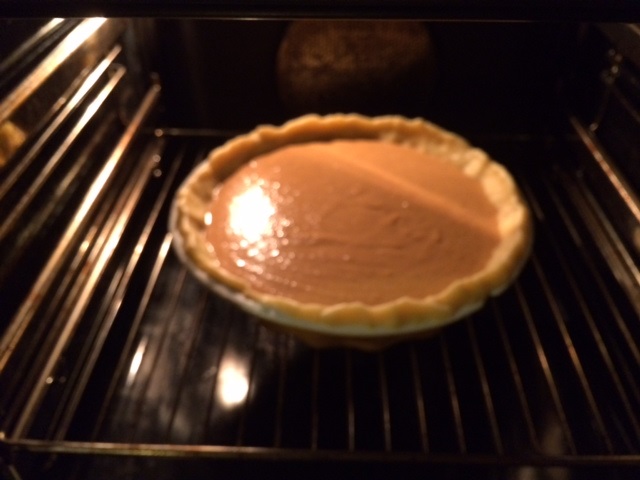
This was not my point, though. The point is that leftover ingredients have led me to bake one of my traditional, original recipe pumpkin pies. I have a big container of cream, loads and loads of brown sugar, tons of eggs… so pumpkin pie seemed like a delicious plan.

pumpkin pie in the oven

pumpkin pie in the oven

Disappearing returns: Raspberry-oat bar cookies

Standard

Among the easiest cookies you can possibly make, raspberry-oat bars are also versatile (just substitute raspberry jam for some other jam or dulce de leche or whatever you want. They are pretty good with cherry!). I make these bar cookies all the time.

The funny thing is that I used too much jam this time so some of the middle bars got sticky and gooey – not the nice crispish crust these bar cookies should have. But it didn’t matter. These were still among the first cookies gone during the recent big bake to end 2013.

Definitely one of the easiest things anyone can make on their own.

Already depleted plate of raspberry-oat-bar cookies

Already depleted plate of raspberry-oat-bar cookies

Raspberry-oar bars
3/4 cup raspberry jam (I am not sure I measured this. I simply bought a jar of raspberry jam, strained the seeds out and used everything that was left)
3/4 cup butter
1 cup brown sugar
1 1/4 cups flour
1 1/4 cups oats

Preheat oven to 325F.

Cream butter and brown sugar. Add flour; mix. Add oats, and stir to combine. Spread 2/3 of this mixture in a 9×12 rectangular pan, and press it firmly down with fingers.

Spread the jam on top but do not let the jam touch the sides of the pan. Sprinkle the rest of flour-oat mix over the top.

Bake 35-40 minutes. Cut into small bars. Or big bars, if you prefer.

Sorted for shortbread – Honey almond shortbread

Standard

It’s pretty much a given that when I bake, I will bake basic shortbread, which my friend Esteban always says is “full of win”. (One of our other former colleagues – from Poland perhaps – was confused when Esteban said this, “Full of win?” as if “win” were an essential ingredient rather than a descriptor.) A few current colleagues also go for the shortbread first – it’s plain and not too sweet, making it a perfect complement for the first cup of the coffee in the morning. Not too heavy or sweet for eating first thing (unlike quite a lot of the other baked goods). My big Christmas bake was no exception – three rounds of plain shortbread were part of the big Christmas spread.

Shortbread - for the win

Shortbread – for the win

However, I decided to try for the second time ever a recipe for honey almond shortbread. My first try turned out far too brittle so kind of broke into pieces when I tried to cut it. Unlike the regular shortbread, which stays a very light color when baked, the honey-almond version browns quickly and, because of the ingredients inside, does much more easily become dry, brittle and hard to cut into decent pieces – although it was much easier to cut this time than in my past effort. (I knew from experience to keep a close eye on it as it baked!)

honey almond shortbread

Honey almond shortbread
1 cup butter
1/3 cup honey
1 teaspoon vanilla extract
2 1/2 cups flour
1 cup chopped almonds (or other desired nut)
Dark chocolate to melt and drizzle on top (or dip the cookie in)

Preheat oven to 350F/175C. Grease round cake pans.

Beat butter, honey and vanilla together. Add the flour. Mix. Stir nuts in by hand.

Press dough into prepared pans. Score with a knife.

Bake about 35 to 40 minutes. Cool 10 minutes on a rack before removing. Cool completely and then cut according to the pre-scored lines. Melt the chocolate and either dip the ends of the shortbread in the chocolate. Or place the wedges on a parchment sheet and drizzle chocolate on the pieces (you can then sprinkle them with more nuts or sprinkles or other such stuff). Put in the fridge for at least 15 minutes to let the chocolate set.

(This time I did not drizzle chocolate on top. My second try did work out somewhat better than the first.)

Honey almond shortbread - a little shaky

Honey almond shortbread – a little shaky

Africa 101: Togolese radio, stereotypes and Africa in small doses

Standard

“What is Africa to me:
Copper sun or scarlet sea,
Jungle star or jungle track,
Strong bronzed men, or regal black
Women from whose loins I sprang
When the birds of Eden sang?
One three centuries removed
From the scenes his fathers loved,
Spicy grove, cinnamon tree,
What is Africa to me?”

-Countee Cullen – “Heritage

Like many “westerners” (or whatever you want to call us – which is a group of mixed, all-over-the-place folks), I never used to give much thought to the specifics of the African continent. It was some “other place” I had not seen, dreamt of or had feelings about one way or the other. It was not really included in any appreciable way in my education, and I did not know anyone from Africa or who had been to Africa. Thus, it was a nebulous concept – just “Africa” without subtlety and nuance. It was not unlike the application of this blanket term “westerners”. What does it even mean?

Of course when I got older, it dawned on me that Africa is a vast place and the diversity was something I could not even begin to fathom. If each state of the American union, sharing a common language and currency, can each be as different as they tend to be, then the countries and regions of Africa would have to dwarf American diversity in some ways (although of course America is a land of immigration, making it a strange concoction as well. In fact most western countries, through years and years of immigration activity, have become their own strange concoctions).

Still, despite the few little tidbits of specific information I gathered haphazardly – nothing systematic about it – Africa was still just a jumble of faces in magazines or on tv, stereotypes, unusual names, places with ever-changing borders, names and leaders but nothing cohesive.

I could swear I had written about this “incremental introduction to Africa” in a previous blog entry before but cannot find any evidence of it now. All I can find is someplace that I wrote: “It seems that it does not matter how much one protests that Africa (especially sub-Saharan Africa) is not just one monolithic entity. Most will continue to treat this massive and diverse continent as though one remedy, one answer, one strategy works for the entire place.” Not that I was ever that different before really giving it some thought and consideration and a lot of time learning.

Where did all the questioning start? I cannot pinpoint an exact moment. In elementary school, when I was a child, I had absolutely no exposure to Africa or anything of direct African origin, other than some carved wooden turtle knick-knacks my grandmother gave me. They were “made in Kenya”, which she informed me was a country in Africa. It sounded so far off and exotic – very hard to comprehend. Later, in elementary school, our social studies textbook mentioned “Mba, Aubame and Bongo” – the only thing I learned about Africa in my entire public school education. The fact that I remembered only their names and a picture but nothing about where they came from shows only how disconnected this piece of information was from anything else. It was as though the textbook creators wanted to mention Africa but did not really have anything to say about it. (Later, of course, with these disconnected names floating around in my head, I checked into it to discover that these men were figures in la politique gabonaise.)

Later, as late as university, I felt a real elevation in my consciousness about this idea of “Africa” as a monolithic entity. A musician from Ghana, Obo Addy (RIP, 2012), came to my university and lectured about this topic – and it was, even though obvious, as though a light came on. The light of ignorance versus stupidity. Haha. No, I wasn’t stupid – I just didn’t know and, like most people, had no reason to think about these things. How did Ghana differ, I started thinking, from Nigeria, or from Gabon? How, even, did North Africa differ from sub-Saharan Africa? As ridiculously surface-level and limited as this sounds now, for 17-year-old me, it was all new. Meanwhile many of my classmates had spent parts of their lives in places like Senegal and Côte d’Ivoire (I want an Ivorian passport – it has an elephant on the front!) and thus had this air of experience and of being cosmopolitan. They had such a different worldview – or seemed like it – and I had no reason or circumstance to know more than I had before this point in time. I suppose this is partly what filled me with an awkwardness and feeling of inadequacy – that my life then was so sheltered and limited in scope. Even my aspirations, reflecting on it, were so puny and plodding. In a comparative light, my experience, despite being mine, just felt like nothingness. My closest encounters with Abidjan were little French-language profiles in my high school French-language text when we were optimistically introduced to all kinds of characters in le monde francophone. (Naturally I also enjoyed our little vignettes of the Swiss, Canadian, Tahitian and Martinique francophones!) To this day, it is hard to imagine spending part of childhood in some part of Africa (again, high school viewing of the Claire Denis film Chocolat should fill that gap in some one-dimensional, take-a-quick bite kind of way).

But then, all my knowledge about “African things” comes from “take-a-quick bite”, almost accidental approaches. From the strange trend in my life of meeting a string of strange men from Gambia (either in the Turkish fruit-and-veg store I frequented in Oslo to being seated next to a Gambian on an Icelandair flight) to the unusual way that Congo (formerly Zaire) keeps popping up in my life (watching When We Were Kings, reading a book about Congo that I found in Trondheim, Norway, seeing a film about Patrice Lumumba and thinking that maybe – just maybe – there was a mention of Lumumba in a schoolbook in my childhood, but that might just be wishful thinking. It’s hard to resist a story with names like Lumumba, Kasa-Vubu and Mobutu Sese Seko), it is as though I am meant to absorb Africa in small doses.

There was the strange flood of postal letters in both English and French that I received from misguided but hopeful suitors from Togo that put Togo on the map (quite literally) for me. Years ago when I was very active in the postal pen pal community, I used to exchange “friendship books” – small, decorated little booklets one might make for herself or a friend that included some info on interests and the postal address. You would send this to a pen pal, who would include his/her information and forward it to another of their pen pals and so on, until theoretically, this little booklet would be full of decorated pages and addresses of new potential friends. Occasionally these booklets would make their way, somehow, to African destinations. Normally this resulted only in a few unwanted letters (many people actually made a point of specifying on their friendship book pages: “No Africans!” – it still strikes me as kind of a horrible generalization but I imagine people had their reasons). In many cases – and very likely for a good many others – it resulted in a few weeks of receiving 50+ letters, daily, from men in Togo who were, according to their letters, “very excited for our marital relations to begin”.

I had no idea who these men were – where were they getting my address? Eventually one of the letters explained that they had heard an ad on the radio – someone was selling the addresses of women in the once-again-undefinable “west” seeking African husbands. All these guys had paid some undetermined amount of money to get their hands on addresses of women who had no interest whatsoever in an African husband. I imagine some enterprising, entrepreneurial type got his hands on one of these friendship books and used it to make a bit of cash. (Advertising on the radio seems a bit weird, but then I don’t have a clue if the radio in Togo is a normal means of advertising.) After seeing probably 400 or more letters come to my postbox, I really could not take it anymore. I just started throwing them away without opening them. Receiving the letters suddenly felt at once creepy and sad.

But I had my little slice of Togo and took in information I would not otherwise have had.

I met a French guy who had African parents (from Ghana and Benin); I knew quite a bit about Ghana by that time, but Benin was a bit mysterious. I managed to learn that Benin is the only country in the world (or at least at that time) which counts voodoo among its state religions. Voodoo, widely associated with Haiti, is only so associated because of the slave trade. It actually came from places like Benin.

I worked with a guy who was part Tanzanian, part Norwegian, who remarked on the “personal space bubble” of northern Europe. If you were to get on a bus, for example, in Tanzania and sit alone, the next person who got on the bus would sit down next to you – somehow being alone or perceived as lonely or wanting personal space is not perceived as “normal”. Life is much more about being a part of a community.

Eventually getting into development studies, Africa is often at the core of this discipline. My studies have taken me (virtually) to Mali (warfare and the films of Malian-Mauritanian director Abderrahmane Sissako – such as Bamako, which was a film I watched several times for its multilayered commentary). My obsession with news and tendency to watch AlJazeera English (which focuses a lot of attention on Asia, Latin America and Africa – all under-reported on American news channels) has given me insight into Sudan, South Sudan, Central African Republic, Nigeria, Mali – among a million other things, including France’s continued influence in the African sphere, as evidenced by its eagerness to jump into military conflicts and/or peacekeeping (most recently in Mali and CAR).

But it is still a slow and incremental learning process, especially because I am only doing it on screen or paper. I still have not travelled to Africa. But because Africa, African geography, African issues are all so distant and perceived as so esoteric, if you happen to know one or two facts about a given African country, people – sometimes even people from that country – imagine you are an expert. Comparatively speaking, maybe I have become a pseudo-expert – but I am still a novice with so little expertise or experience. After having eaten Ethiopian food perhaps once and knowing that the spongy bread is called injera and is made from teff flour, an Ethiopian guy decided I must know everything about Ethiopia (he was just impressed perhaps that I was not one among the multitudes of insensitive assholes who always reply to comments about Ethiopian food with, “I didn’t know Ethiopians had food.”)

Most recently, I watched a film, Rêves de poussière (Dreams of Dust), which was about a man from Niger who travels to Burkina Faso to try his luck as a gold miner in horrific and dangerous conditions. Cinematographically beautiful, all these films, I am still a geography dunce. I find – still – I always have to look at a map.

The old switcheroo – when M&M cookies aren’t really what they seem

Standard

In recent years, I have baked M&M cookies – probably the most broadly well-loved cookies of the entire repertoire I bake – using the same recipe I use for the other most popular cookie (white chocolate macadamia nut cookies – sadly I don’t make these much anymore because I don’t have a constant supply of white chocolate chips from the US; a former colleague used to bring them to me, but we no longer work together).

The recipe I usually share on my blog for M&M cookies is not the same one as people go to such lengths to rave about. It’s misleading, and I feel in some way like I have pulled a switcheroo operation, falsely advertising, “You can get these results if you use this recipe” – but it is not true because the recipes are patently different.

M&M cookies: I have deceived you

M&M cookies: I have deceived you

Selling a false bill of goods, though, is something we should be used to now. Everything is a bit of a falsehood.