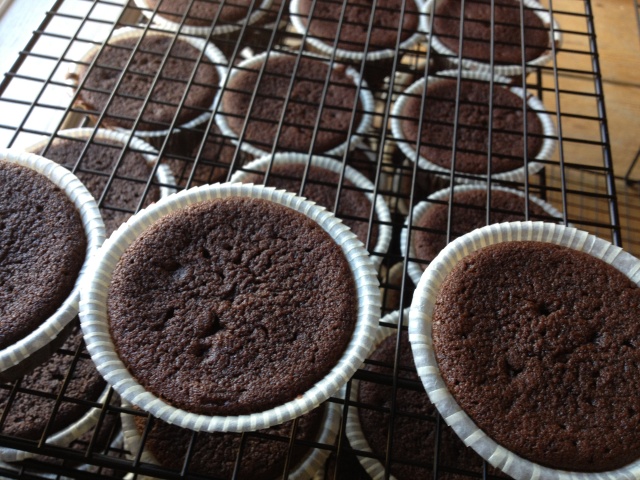
Stuffing things into other things: Vanilla cupcakes stuffed with mini chocolate pudding pies

Standard

Sometime last year I became quite obsessed with stuffing things into other things. This sounds a bit obscene, but what I mean is that I liked the improbable and over-the-top (at least in theory) pairings of peanut butter cups stuffed into chocolate chip cookies or Toblerone candy stuffed into a cupcake. I have kept that stuffed theme going into this year, occasionally dreaming up some new thing to put into a cookie or cake. The whole idea of baking an entire pie into a cake gained traction in recent years, and while I have not yet had the fortitude or occasion to try that experiment for myself, I have tackled the mini pie inside a cupcake.

I give you the mini chocolate pudding pie inside a vanilla cupcake with what should be chocolate Swiss meringue buttercream that never quite took shape or firmed up the way a Swiss meringue frosting should (but it seemed fine enough to use in any case).

Vanilla cupcakes stuffed with mini chocolate pudding pies
Vanilla cupcake batter:
3/4 cups butter, softened
1 1/2 cups sugar
3 eggs
2 teaspoons baking powder
1/2 teaspoon baking soda
1/4 teaspoon salt (if using unsalted butter)
2 teaspoons vanilla
2 3/4 cups flour
1 1/3 cups milk

Chocolate pudding:
You can make your own or buy a couple of packages of instant chocolate pudding.

Pie crust:
Make your own (find a decent recipe for pie crust here). Or use pre-made pie crust if you can find such a thing.

Preheat oven to 375F/190C. First roll your pie crust out and use a glass or pastry cutter that is about 2.5 inches in diameter. Cut out rounds from the crust. Press the dough into a lightly greased mini cupcake pan. Either use pie weights or dry beans to weigh down the middle of the pie crust (they will puff up otherwise) or poke a few holes in the pastry bottoms. Bake for about 10 minutes until the crust turns slightly golden brown. Set aside and let cool.

Make the pudding according to your instructions.

Fill the cooled crusts with pudding and refrigerate.

For the cupcakes, preheat the oven to 350F/175C. Cream the butter and sugar together until fluffy. Beat in the eggs, one at a time. Then add the baking soda, baking powder, vanilla and salt. Add the flour and milk in alternating turns with the mixer on low. Beat mixture just until combined/smooth.

Fill cupcake liners in your cupcake pan with about one heaping tablespoon of batter. Top this with one of the chocolate mini pies and gently press it into the batter. Put another heaping tablespoon on top of the pie to fully cover it.

Bake for about 20-25 minutes until the cupcakes have begun to turn a light golden brown and the cupcake top will spring back when touched. Let the cupcakes cool in the pan for about ten minutes before removing them to a wire rack to cool completely.

You can frost as desired. I made a chocolate Swiss meringue buttercream (recipe here).

Torching the tops – broiler in overdrive and creme brulee cupcakes

Standard

In summer 2011, I had one of the only real arguments (in that it was sustained and stupid) of my adult life when a guest at my house yelled at me for not owning a toaster. He attempted to make toast using the broil feature of my oven, only to end up with a couple of slices of fully charred bread. In fairness, the broiler in my oven is temperamental. It seems to do nothing, nothing, nothing, and suddenly, it kicks into high gear, and if you are not watching the oven’s contents closely and carefully, it will turn rapidly into inedible charcoal.

Knowing this about my oven, I ended up with not one, but two, four-slice toasters (I can satisfy a great deal of toast demand now). Otherwise, with other projects, I broil with caution.

When I made lemon meringue cupcakes, I used the broiler and basically did not take my eyes off them as long as they were under the broiler.

When I decided to try out an experiment with crème brûlée baked into a vanilla cupcake, I knew I either needed to go out and buy a culinary torch or try my luck once more with the fussy broiler in the oven. I decided to go with the latter option because, while I could certainly use a culinary torch sooner or later, I do not have an immediate need for one, and if the crème brûlée cupcakes turned out less than stellar, I would not be planning to make them again. While being a full proponent of there being a proper tool for every task, I do not feel compelled to acquire every tool for every task I could possibly do, preferring to limit myself to the tools that will go to the best and most frequent use.

I also knew I had to find out if this would work for me before I invested too much time and effort, so I went with a crème brûlée packaged mix (the horror!). I might try this another time using homemade filling.

Vanilla cupcakes
3/4 cups butter, softened
1 1/2 cups sugar
3 eggs
2 teaspoons baking powder
1/2 teaspoon baking soda
1/4 teaspoon salt (if using unsalted butter)
2 teaspoons vanilla
2 3/4 cups flour
1 1/3 cups milk

Two packages of crème brûlée mix

For the cupcakes, preheat the oven to 350F/175C. Cream the butter and sugar together until fluffy. Beat in the eggs, one at a time. Then add the baking soda, baking powder, vanilla and salt. Add the flour and milk in alternating turns with the mixer on low. Beat mixture just until combined/smooth.

Fill cupcake liners in your cupcake pan to about 3/4 full. Bake for about 20-25 minutes until a toothpick inserted in the center comes out clean. The cupcake will just have started to turn a slight golden brown color. Let the cupcakes cool in the pan for about ten minutes before removing them to a wire rack to cool completely.

Crème brûlée cupcake assembly
When cupcakes are cool, use a melon baller or a small knife to scoop out the centers of the cupcakes, leaving an approximately one-inch edge around the border and being careful not to reach the bottom of the cupcake, leaving a small layer of cake on the bottom of the cupcake. Once this is done, you can set the prepared cupcakes aside. (Scooped-out crumbs can be used to make cake pops.)

Crème brûlée
Follow the instructions for your crème brûlée, either on the package or from scratch, depending on your method. When the crème is finished cooking on the stovetop, immediately pour it into the waiting cupcakes until the cavities are full but not overflowing. Let the filled cupcakes sit for an hour to settle, and then refrigerate for another hour until ready to serve.

When ready to serve, sprinkle caramelizing sugar on top of the cupcakes and put under your broiler for three minutes or until the sugar has melted (or use a culinary torch to achieve the same results).

I did not follow these exact directions since I was not going to be serving them directly and unfortunately left these for last to prepare and did not have time to let them sit at room temperature or in the fridge before doing the broiling on top. I plodded ahead with the broiling almost immediately after filling the cupcakes and hoped for the best.

I did not hear any feedback one way or the other about these. I may try them again but will try with my own crème brûlée recipe and may by then have a proper culinary torch.

Political debate analysis, losing sight of the big picture, frustration, transportation difficulties and dulce de leche bundt cake

Standard

Sometimes I can be so forgetful. When “staging” the baked-good offerings in my office (which involves a considerable amount of labor that goes well above and beyond the mere baking of these things), the process involves packaging, packing, transporting and then somehow getting everything from the car into the office, which is on several floors with varying levels of available space and quality for “preparing”, and then hopefully feeling motivated enough to take pictures of the final products. Sometimes I do this during the baking process, but sometimes I cannot be bothered, leaving me to at least photograph things just before they are eaten, but sometimes, while I manage to take a few pics, I don’t get to the point where I cut a cake or cupcake open to get a good view of what the inside looks like. I wish I had pictures of, for example, the inside of the dulce de leche cake, in order to display the ribbon of dulce de leche that is baked into the subtly dulce de leche-flavored cake.

But, as I wrote, I can be so forgetful. Or maybe even just lazy. This week I took the baked bounty to the office the night before serving and spent most of the night carrying the baked stuff from parking garage to the various floors of the building (I distribute the baked stuff to several floors so people can more easily access it) and setting everything up on plates as well as frosting the cupcakes (which I don’t do until I get to the office, making them far easier to transport). I wanted to make sure I would get to see the entire US presidential debate. My debate viewing was a leisurely affair, alone in the office in the middle of the night spreading blobs of frosting onto cupcakes while listening to Mitt Romney go on an aggressive attack – which strikes me as both uncivilized and unbecoming behavior in a potential president, particularly when lying, bluffing and playing fast and loose with the facts. (But we already know how little facts matter.) When it was not the facts, it was just disingenuous bullshit – him stating with false concern in his voice that he is running for president to help the middle class and because people are suffering. Suffering? What would Romney understand of suffering – either in reality or conceptually? After his “47% of people are freeloaders who do not care about their own well-being (and who believe they are somehow entitled to food!?)” comments (which sounded very real and sincere, particularly since he did not know he was being watched or filmed), I do not see how anyone can trust him or regard anything else he says as honest.

While I fully understand that Obama did not roll out his best debate performance, I think most pundits and commentators, and indeed people, lose sight of the fact that these debates are merely that – performances. A 90-minute event, hitting an imaginary ball back and forth. What does the behavior of each candidate in the debate tell us about how he might govern? Maybe nothing. Maybe it will tell us that Romney will continue to flip-flop and change his mind and pander to whomever he is speaking to at any given time. (The “Etch-a-Sketch” presidency to which various media outlets are constantly referring.) Beyond which, we never heard a single specific thing Romney might do other than throw Jim Lehrer (as well as Big Bird) out on his ass by cutting funding to PBS (as if that would contribute so much to deficit reduction).

I feel that the incumbent president, despite needing to fight for his job, has an obligation to be a bit less aggressive and more sober. After all, he is the sitting president. He is still doing the job of the president. He needs to be a bit less defensive and more reflective. That said, Obama may have done well to refer to some of Romney’s gaffes, tying the extensive talk about Medicare and health care to Romney’s careless and heartless comments on the “freeloading” half of the population for whom Romney supposedly felt such compassion on debate night. (And maybe only on debate night. And even if we give Romney the benefit of the doubt and assume that he does actually care about people and their suffering, the idea that he talks about them in disparaging terms in certain company but paints a totally different picture in other company, illustrates clearly how he will say whatever he needs to say but never just stands his ground and, more broadly, lacks character and conviction.)

In another broad sense, I am constantly amazed – but somehow not remotely surprised – by how basic political conversations (like the debates, including all the debates in the last few election seasons) are surface level and not at all substantive things. Worst of all, the commentators and media idiots follow the debates with opinions that claim the debate/discussion was “heavy on policy” and “wonky” … are people so lowest common denominator that just mentioning the word “policy” or “plan” in a debate somehow makes people edgy and bored and makes them think they are hearing something complex and in-depth? It pains me, and perhaps it always has, to think that the media feed this kind of opinion to consumers, in part because American consumers ARE fast-food and surface-level in their approach and in part because they have been conditioned to be this way by a crumbling, uneven education system and a media that focuses on entertainment, sound bites and the short-term game over real analysis and long-term views (and yes, facts). The debate was disappointing to me not because Romney, in media review, “kicked Obama’s ass” but because the American media and American public actually view the debate process this way at all – a win-lose competition as opposed to an exchange and debate of ideas and differences between two candidates (and parties). What we saw was one desperate man who would have said anything he had to to “win” and another man who just did not seem to want to be there at all.

-End of rant!-

By the end of the debate, the baked goods had been redistributed (what a socialist I am!) to three floors of the building, and freely available (even to those who share the building with us but do not work in our company). One day perhaps I will identify an easier, more streamlined way to bring the baked goods to work, but for now, it remains a challenge.

Dulce de leche bundt cake
1 1/2 cups dulce de leche (for an easy dulce de leche recipe, click here)
1 cup softened butter
1 cup dark brown sugar, packed
4 eggs
2 teaspoons vanilla
1 cup buttermilk
1 tablespoon baking powder
1/2 teaspoon baking soda
1/2 teaspoon salt (if you used unsalted butter)
3 cups flour

Preheat oven to 350F/175C.

Butter and flour a 12-cup bundt cake pan.

Whisk dry ingredients together and set aside.

Cream butter and brown sugar together until light and fluffy. Add one cup of dulce de leche. Mix well, then add the eggs one at a time, scraping the sides of the bowl after each addition. Mix in the vanilla.

Turn mixer to low speed and alternately add in the dry ingredient mixture with the buttermilk.

Mix until just combined. Put about half the batter into the prepared bundt pan. Using the other 1/2 cup of dulce de leche, add the dulce de leche to the cake, making a ring of the dulce de leche in the center of the cake batter in the pan. Once this is done, carefully add the rest of the batter evenly on top of the ring of dulce de leche. Smooth it out.

Bake about 50 to 55 minutes until a toothpick inserted in the center of the center comes out clean.

Allow the cake to cool in the pan for about 20 minutes before inverting the cake onto a wire rack to remove from the pan. Allow the cake to cool completely.

You could create a caramel sauce for the cake before serving, or do as I did – simply sift vanilla sugar on top of the cake.

Love em or hate em – Licorice cupcakes

Standard

(Black) licorice is one of those things that is a love it or hate it proposition. It seems that Scandinavians (and possibly the Dutch) tip the scales in favor of “love”. I rarely meet people in these parts of the world who do not love licorice (both salty and sweet varieties) and indulge in it with reckless abandon (and “indulge” is an appropriate word here – the black stuff can make blood pressure skyrocket and has other unpleasant side effects). Still, all the baked goods leave something to be desired in the health department – and considering that I am serving cakes and cookies to a largely Scandinavian audience, it seems only right that I try to make cupcakes that would satisfy their tastes.

I have tried to make licorice cupcakes before – I had some licorice powder, which did absolutely nothing to the flavor of the cake I baked. I have given much thought as to how I might capture the licorice essence. As strong as the smell and flavor of licorice is, it has not come through easily or well in most of my experiments.

The answer, it seems, is to melt licorice candy (I used some Haribo licorice nappar candy, but a softer candy would melt better and would be recommended in future attempts at making this cupcake – especially when I tried, and failed, to make licorice frosting – I ended up frosting the finished cupcakes with honey frosting and sprinkling some licorice sprinkles on top).

A discerning taste tester and avowed licorice lover at the office reported that these cupcakes were tasty.

Licorice
Use about 12 ounces (340g) of soft black licorice (sweet or salty, depending on your preference)

Melt over a double boiler or in the microwave. You will need to mix in up to 10 tablespoons of water to ensure a smooth melt. Do not mix in that much water to start. Start with four or five tablespoons, melt and stir and see if the mixture needs more.

It is also nice to melt the licorice most of the way but leave a few small bits/pieces unmelted … it creates little bursts of color and flavor in the finished cupcake.

Preheat oven to 350F/175C.

Licorice cupcakes
1 cup butter
1 cup brown sugar
1 1/2 cups flour
2 teaspoons baking powder
4 eggs
1/2 teaspoon of salt (if using unsalted butter)
Melted licorice mixture

Cream butter and sugar together. Add the melted licorice mixture. Mix well. Then add the salt and baking powder until well combined and smooth (the mixture will be a brownish color).

Add the flour and stir until just combined (do not overstir).

Fill liners in a cupcake pan about two-thirds full. Bake for 18 to 20 minutes until a toothpick inserted in the middle of a cupcake comes out clean.

Let the cupcakes cool fully on racks and frost.

As I wrote, I had a total failure on the frosting front – I will use softer, more easily melted licorice next time to make the final product usable. Meanwhile, I used a honey frosting (butter, powdered sugar, honey and a drop of cream) and licorice sprinkles to top these off.

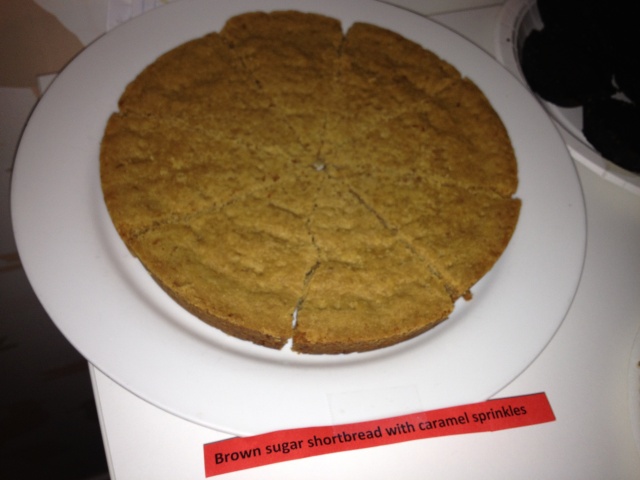
Brown sugar shortbread

Standard

Classic shortbread, which I have made a million times. I used brown sugar instead of powdered sugar and threw in some caramel sprinkles.

4 cups flour (approx 512g)
1 1/4 cups powdered sugar (156g)
1 teaspoon baking powder (4g)
1/4 teaspoon salt (1.4g)
2 cups butter (452g)

Knead all ingredients together. Press into ungreased pans (or molds) and prick the top with a fork. Bake 45 minutes in oven preheated to 160C/325F.

Beet red velvet cupcakes with cream cheese frosting

Standard

I have chronicled my trials and tribulations with the formidable red velvet cake before. From the not-so-successful results to successful but potentially toxic results to preparing for a more natural version of these vividly colored cakes (and the mess that ensued).

The result…

The use of peeled, juiced raw beets achieved and maintained the color desired. In my study of the topic, and in the desire to avoid food coloring, I learned that cooking the beets would dim or destroy the red color (the main reason for using beets!). Perhaps there is a way to account for and prevent this (using lemon juice in the cooking, perhaps?), but it seemed just as easy to peel a handful of beets and throw them in a juicer to get pure, raw beet juice and fine beet pulp, which turned out to be ideal for these cakes.

In addition to the raw beet juice, I changed the recipe slightly from the original recipe I had used (I may try the original recipe again just to see if it makes a difference).

(Beet) Red velvet cupcakes
3/4 to 1 cup of beet pulp
1 tablespoon lemon juice
1 1/2 teaspoons rice vinegar
1 cup sugar
1/2 cup butter, softened
3/4 teaspoon vanilla
3/4 teaspoon salt (if using unsalted butter)
3/4 teaspoon baking powder
1 1/4 cup flour
2 eggs
1/2 cup buttermilk
1 tablespoon cocoa (unprocessed, natural cocoa powder)

(To make the beet puree, I used a juicer. I peeled four or five beets, threw those into the juicer, which separates juice from pulp. I used the resulting 1 cup of beet pulp and then used some of the beet juice to achieve the right level of liquid – I did not measure this, so it might be a trial and error process for others who attempt this.)

Preheat oven to 350F/175C.

Mix the beet pulp, lemon juice, rice vinegar together.

In a mixing bowl, cream the butter and sugar, add the eggs, then the vanilla. Add the beet puree mixture.

Sift together dry ingredients (flour, salt, baking powder, cocoa) and mix the dry mixture into the butter-beet mixture alternately with the buttermilk. If the batter is really thick, you can add a bit of the beet juice from the juicing process. You do not want this batter to be too thin, however.

Bake for about 20 to 25 minutes in lined cupcake pans. A toothpick inserted in center of the cupcakes should come out clean. Cool in pan on rack for two or three minutes before removing the cupcakes from the pan and allowing them to cool completely on racks.

Frost with cream cheese frosting.

Cream cheese frosting
8 ounces (227 grams) cream cheese, at room temperature
6 tablespoons (3/8 cup or 85 grams) butter, at room temperature
3 cups (330 grams) powdered sugar
1 teaspoon vanilla extract
1 teaspoon lemon juice [juice of 1/2 a lemon]

Cream together cream cheese and butter in a mixing bowl.
Slowly sift in powdered’s sugar and continue beating until fully incorporated. Mixture should be free of lumps.
Stir in vanilla and lemon juice.

I did not use this exact frosting recipe and ran out of powdered sugar, so my frosting was a bit less than solid – but no one seemed to mind much. The handful of people who provided feedback, as lab guinea pigs do, said they were really good. Still, I think this is one recipe that can continue to be improved on. And filled with beets, perhaps we can convince ourselves they are slightly healthy! (And just for Janne and Esteban: Remolacha!

Tipsy cake – Guinness cupcake and Baileys Swiss meringue buttercream

Standard

At last, a successful attempt at Guinness cupcakes and Baileys frosting. I doubled the recipe, so I had an exceptional number of these, which I spread liberally throughout the office – ensuring of course that my Irish friend and colleague had easiest access to them!

Guinness cupcakes (or you could use any stout beer you want to use)
1 cup butter
1 cup Guinness (or other stout)
2/3 cup unsweetened cocoa powder
1 cup brown sugar
2 cups flour
1 cup white sugar
1 1/4 teaspoon baking soda
2 eggs
1/2 cup sour cream

Heat butter, Guinness, cocoa and brown sugar on the stovetop until the butter is melted and the mixture comes together cohesively. Set aside and let cool to room temperature.

Mix flour, white sugar and soda. Add the Guinness mixture. Mix well.

Beat in the eggs, one at a time, followed by the sour cream.

Divide into lined cupcake pans and bake at 350F/175C for about 20 to 25 minutes (until toothpick inserted into the center of the cupcakes comes out clean). Let cool 10 minutes before removing from the pan. Place on a cooling rack to allow to cool completely before frosting.

Baileys Swiss meringue buttercream frosting
3 egg whites
3/4 cup sugar
1/2 cup unsalted butter, cut into pieces
3 tablespoons Baileys

Mix the egg white and the sugar over a double boiler. The sugar should be completely dissolved when you remove it from heat. Pour the mixture into a large bowl (preferably the mixing bowl of a stand mixer — Swiss meringue is mixing intensive, so a stand mixer works best). Whisk on high speed until stiff but still wet peaks form. Continue to beat for about five or six minutes after these peaks form.

Switch to the paddle attachment and turn the speed to medium low. Add the butter in one or two tablespoons/pieces at a time. The mixture might start to look lumpy and curdled. Don’t worry. Keep mixing. When things start to come together, beat in the flavoring (in this case, the Baileys) and keep beating for another two minutes. It might take some time to get to the right texture. You will know when it comes together in a solid, fluffy, frosting-like consistency.

Frosted days: Baked results for Thursday

Standard

No, frost (as in ice crystal type frost) has not set in yet. I am thinking about how tomorrow will be filled with making frosting. All those cupcakes I made need frosting. I have to make the frosting and then transport it with me to Oslo and frost all the cupcakes when I get there. I don’t have sufficient transportation options for taking fully frosted cupcakes with me. I am not a big decorator anyway, but it is not as though I can make lovely frosting designs on the cupcakes thanks to this transport challenge. Sigh.

So… the list of everything that is coming with me to work on Thursday (I think this is everything, but can’t be sure)…

*Kahlua coffee cupcakes
*Lemon cream oat bars
*Mini chocolate pudding pies baked into vanilla cupcakes
*Crème brûlée cupcakes
*Dark chocolate hazelnut mini tarts
*Oreo truffles
*Highly experimental red velvet cupcakes
*Dulce de leche bundt cake
*Carrot-pineapple cake with a brownie layer in between carrot layers
*Brown sugar cupcakes filled with Toblerone candy
*Brown sugar shortbread
*Licorice cupcakes
*Banoffee cupcakes
*Vanilla orange biscotti
*Guinness cupcakes with Baileys frosting

Lemon cream oat bars

Standard

One of the simplest things I have ever made. Lemon cream is literally a can of condensed milk mixed with lemon juice and lemon zest… and that gets sandwiched between an insanely simple bar-cookie crust. I would argue that the simplicity is the reason a lot of almost-non-bakers opt for bar cookies (to me they just seem like something a(n) (American) Midwestern soccer mom might make. Not sure why bar cookies feel Midwestern to me. They just do. On occasion, though, they join the rest of my repertoire.

Like today.

Lemon cream oat bars

Crust:
1 1/3 cup flour
1/2 teaspoon salt
1 teaspoon baking powder
1/2 cup butter
1 cup brown sugar
1 cup oats

Preheat oven to 175C. Mix and press half the mixture into an 8-inch by 11-inch greased pan.

Filling:
1 can sweetened condensed milk
1/2 cup lemon juice
zest of 1 lemon

Mix well. Spread onto bottom layer of crust.

Top the filling with the remaining crust until fully covered.

Bake 20 to 25 minutes. Cool. Once cool, refrigerate.

Once chilled, cut into bars and serve.

Banoffee cupcakes – Baking experiments to eat at one’s own risk

Standard

Beware of baking experiments. As I have written before, I don’t taste any of these things, so the experiments especially are… well, totally experimental. This means that no one has tasted them before they end up on offer in the workplace, making my colleagues unwitting (even if entirely willing) lab rats. People take their taste buds into their own, eh, hands, every time – although this rings true more starkly when I am making something I have never attempted before.

Behold the banoffee cupcake, which is aptly named for banana and toffee mixed together. I made a lightly toffee-flavored cupcake and will fill it with caramel and banana and frost with dulce de leche Swiss buttercream. I doubt that this will be the final word in banoffee cupcake experimentation, however.

Banoffee cupcakes
3 cups flour
2 teaspoons baking powder
1/2 teaspoon baking soda
12 tablespoons butter, softened
1 1/3 cup sugar
1/2 cup neutral-flavored vegetable oil
4 eggs
2 teaspoons vanilla
3/4 cup buttermilk
1/2 cup dulce de leche (or some kind of thick caramel)

Preheat oven to 175C.

Whisk dry ingredients together and set aside. Cream butter and sugar, add the eggs, one at a time, scraping the sides of the bowl after each addition. Add the vanilla and oil. Alternately add the dry ingredient mixture with the buttermilk in three additions. Add the half-cup of dulce de leche.

Put batter into cupcake liners and bake – probably about 15 to 20 minutes, until a toothpick inserted in center comes out clean. I used larger cupcake liners and it took closer to 35 minutes for mine to bake through.

To assemble, you can decide for yourself how best to deal with it. I am going to cut the center out of the cupcake and fill with dulce de leche and banana slices and frost with dulce de leche frosting. Maybe sprinkle some graham cracker crumbs and/or crushed Daim candy on top. We shall see.

This would be infinitely easier in cake form rather than individual cupcakes.