There must be a lot of overly aggressive, unhinged cab drivers. I came across this article about a girl taking a cab ride that took a turn for the creepy, and I remembered my own very similar taxi ride in from JFK into the city. All the same feelings the girl describes crossed my mind. Was I soon going to be dead or raped? All the weird suggestions and insistence on “being in love” with me, after having me, a complete stranger with a language barrier in his cab for five minutes, also came to pass. This cab driver was Egyptian, and even though I took a different path from the girl in the article – I lied and said I was in a relationship, he was persistent about his love and how I should call him any time, night or day while in the city. He was pushing and pushing and really had no concept of how uncomfortable a trap the whole thing felt.
The article triggered not just this unpleasant memory but memories of all the times, as a woman, that I have been in uncomfortable situations like this. How many times have I wanted to be completely invisible or genderless? How is it that these men have no sense of how threatening, frightening, disgusting and discomfort-inducing these kinds of persistent and horrifying encounters are?
The admin mindset
I was recently in a meeting in which one of the middle-management layer (a middle-aged woman) kept repeating, rather inexplicably, “If you get anyone treating you like you’re an admin, giving you admin tasks, push back. We are professionals.” No one has treated anyone like an admin, so I could only assume that this “admin mindset” is internal. Yes, there was a time and a place – and there probably still is – where this treating employees (especially women) as admins was/is common. But in this situation, the admin mindset was all about self-assigning value to work. Somehow, despite this woman being in a senior position, she was assigning this label to herself. And maybe people do treat her like an admin because she sets herself up to be a kind of senior-level, paper-pushing process goblin.
I wanted to say to her: “You feel like an admin because you act like an admin”. Sure, people may not understand what you do, but the perception you talk about is your own. Is it the person’s age? The lack of self-confidence? The sense of going crazy?
I can’t sleep. Checking out the ridiculous Eastbound & Down and overdosing on cute pics of twin baby polar bears. Thinking I will switch over to news even though I am tired of hearing about Crimea now. How is that story a surprise to anyone?
Reading about the talented and alluring Yasmine Hamdan – always wish I knew Arabic.
Love – I never knew I needed or wanted to hear sweet words. You can just call me a wee marshmallow fox. I have completely melted.
I like multimedia, multitask, multithought, multifeeling multistories that are as full of random abandon as I am.
Nerves, nerves, nerves and nerves. Yes, by all means, have another cup of coffee (well, no, actually don’t). After all, early to bed, early to rise… will not necessarily make one wise but will get me where I need to go on time.
Driving north, the temperature is much, much lower. Not that much further north – snow on the ground and all. Driving on winding, country roads, I always find myself elated when I get long stretches all to myself with no other cars to impede my path. Usually I drive to work at 2 in the morning, and thus avoid almost all other cars. But coming back, it is usually evening – tons of cars who definitely view speed limits as “letter of the law” over “spirit of the law”. It is not even that I want to be a speed demon – when I am on the road alone, I don’t necessarily exceed the speed limit. I just don’t want to be stuck behind someone who is going exactly the speed limit (or less) and who has some kind of twisted love affair going with his/her brakes.
Since I was a baby, I have been afraid of mannequins. I am not literally afraid of them now, but I do find them creepy. I suppose it dates back to my having seen mannequins in a museum (Eisenhower Museum probably – the boyhood Kansas home of good old Ike) my parents took me to when I was three or younger. I had nightmares afterwards about the mannequins crashing out from behind the glass – maybe it was not even nightmares and was just me imagining that they would crash out and try to get me?
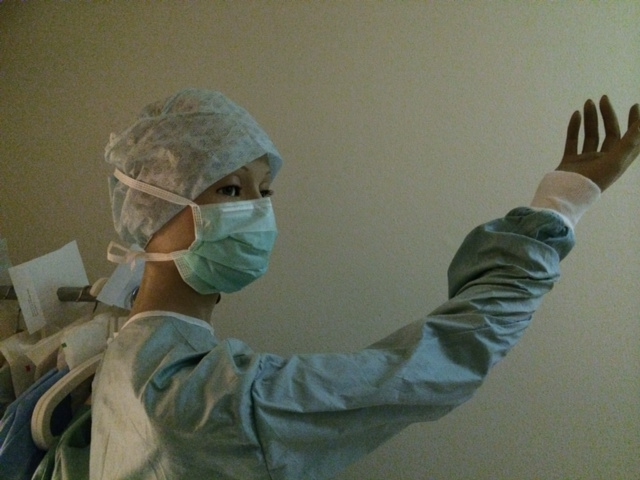
My office is full of mannequins (not to be confused with the film, Mannequin, about which I have improbably written before), which are unnerving enough just standing there in unnatural poses modeling clothes. But in my office they are wearing surgical gowns, caps and face masks. The face masks especially add an extra creep factor – only the hauntingly vacant eyes of the mannequin are visible.
The cold, dead eyes of the mannequin
When I went into the small printer room off the main office area today, I was surprised to find one of the mannequins hidden in a dark closet. Its awkward arm/hand gesture looks a bit like a twisted “Heil Hitler” salute. What is she pointing at? An exit?
The other day a colleague told me that she gave her daughter a pair of roller skates for her seventh birthday.
It made me think of a tale I have been told about when I was three. My neighbors had a skateboard, and I was determined that I would have one too. My parents told me I could have a skateboard when I was “a big girl”. Sometime later – not sure if it was days or weeks – they told me I could do something myself because I was “a big girl”. I replied, “No, because if I was a big girl, I would have a skateboard.”
Or when my grandma came to visit my family, she took me to my bedroom for a nap – but not long after that, I reappeared from my room and told my mom, “I put grandma down for her nap.”
Let’s not even touch the fact that by the time I was three, I already had my second boyfriend.
I was a take-charge, personality-filled leader then.
I don’t know what happened after that – it is like I became a different person, something in me snapped before I turned four.
But when I was three, I was very alive and a force to be reckoned with.
The other day, cultural reference point and professor Anita Hill, was Jon Stewart’s guest on The Daily Show. It has been 22 years since the US Senate judiciary hearings that preceded the confirmation of Clarence Thomas to the US Supreme Court. Hill has lived what most would see as a fairly private life since the hearings, in which she was subjected against her will to all kinds of humiliating and embarrassing questioning before a panel of all-white, all-male senators. Thomas was confirmed (by a narrow margin), but Hill’s testimony perhaps shed a light on the issue of sexual harassment in ways it had never been before. As she explained on The Daily Show, a younger generation of women, who may have heard of her, do not know the whole story behind why she is known. A new documentary about her story, Anita: Speaking Truth to Power, debuts in theatres soon – and the story is one that needs to be told.
I have often reflected on how hard it is to fully understand history and precedent without context. One example is that of the struggle for women’s equality and feminist theory. It is misleading to frame – or phrase – it this way because there really is too much nuance and depth just in this struggle – too many offshoots and movements in every struggle. That is, women’s studies can be a very broad umbrella covering everything from women in history to “mainstream” feminism to radical feminism – to all kinds of perspectives about “subcategories” of these “feminisms”. I put quotation marks around all these terms because they have been analyzed to such extremes by the academics in gender, cultural, anthropological and sociological studies, that, even if I could make sense of all the categories, I don’t think this is the place to go into it. It’s enough just to say that discussing one woman (Hill) who “spoke truth to power” crosses into multiple categories and is intrinsic to so many of the narratives of these categories. But ultimately it comes down to the story of one woman, which, when put into context, shows the outline of a much bigger, longer and more complex struggle.
When I dubiously undertook an MA degree in gender studies a number of years ago (which I just as casually dropped), I found it easy to dismiss a lot of the rhetoric and theory around women’s studies. A lot of it, it seemed, was anti-man/anti-human in many ways and tried to assign some kind of superiority to women. I was not interested in that. But if one were to continue reading and digging in, it would be possible to find the important links between theory and academic rigor on the subject and real-life applications. When I was enrolled in the program, I found myself complaining to a former colleague, a woman who was much older than me (my parents’ age), who had been working in a male-dominated, highly technical US government agency for her entire career. While she took some of her opinions (anti-man) to extremes, she made good points about how she had seen things markedly change in the workplace for women over the course of her career, even if on some level it still felt backwards at times. When she began, the sexual harassment Anita Hill highlighted as well as the tendency for male employees to treat female employees, at whatever level, as their personal secretaries (at best) or as sexual objects (at worst) was commonplace and accepted. And what woman, perhaps just glad that she was able to get the job she had, was going to make waves about that?
My former colleague’s point contextualized a lot of the theory I read about – institutional discrimination and the unspoken, tacit acceptance of harassment (and the lack of a definition of, let alone a prohibition of, said harassment) were also the norm for a long time. Only slow, incremental work against these ingrained ways of existing in workplaces and the courage of the women who stepped forward – either in their workplaces or in the scholastic realm (or a combination of both) could create the environment I took for granted when I started reading these gender studies texts.
This dovetails with an unrelated story I recently read about the need for academics and intellectuals to engage in public discourse and be actively on political and policy issues. The article discusses two professors who were recently dismissed for reasons related to not bringing in enough grant money; not because they did not deliver quality education, mentorship or broad political engagement. The whole thing disturbed me, as I realized that these professors, and professors like Anita Hill, are essential to both good education and to public and civil dialogue and policymaking. When I read my gender studies textbooks and was mystified by a lot of nonsense that needed to be waded through to get to genuine understanding of issues, I needed this kind of leadership and mentorship to contextualize the work.
The Nation article referenced above cites a New York Times op-ed article, which entreats academics to get involved in public debate, stating that today’s academics “have fostered a culture that glorifies arcane unintelligibility while disdaining impact and audience”. This captured exactly what I felt – the “hyperspecialization” had erased context from the sometimes very thoughtful and rigorous academic work. True mentors, engaged politically and in society, provide perspective and context and an historical framework. While the professors cited in the article have been asked to leave their positions for fundraising reasons, I suspect the whole higher education system in America is following the corporate model, and these professors are marginalized by doing what they really should be doing. And Anita Hill – well, she has found her niche – but not without having been punished publicly and by much of society for having been a kind of whistleblower for the real issues that underpin the academic thinking that she (and other gender studies/women’s studies professors) works to make a larger part of public discourse. People trying to make real change and have a lasting impact get punished no matter how they go about it.
This is not to say that sexual harassment no longer exists – I am quite sure it does. But a sensitivity to it has been raised, at least in most private and public sector workplaces. There are mechanisms in place to try to deal with it. Is the system perfect? No. But the Anita Hills of the world helped us reach a place where sexual harassment is not tolerated as just a part of doing business.
On an only semi-related note, when I saw that Anita Hill was the guest on The Daily Show, the first thing that came to mind for me was a line from a Sonic Youth song (“Youth Against Fascism”: “I believe Anita Hill…”). I often think about these kinds of cultural references in songs. They are so timely in the moment, and the people embracing these songs can instantly connect to what these references mean. But without reminders some of the references become lost. I should probably make a list of 1990s references just for the sake of seeing how often this happens and how often I find myself explaining these references to younger people.
For now, I can only immediately think of references from Ice-T’s O.G. album in which he referred to Tipper Gore and later to “Bush and his crippled bitch”. What person today (not of my generation) is even going to remember what these mentions referred to? People barely even remember Tipper as the unfortunate victim of Al Gore’s staged kiss during the 2000 presidential election, let alone remember her as the crusader who wanted to put parental labels on CDs warning about explicit lyrics. This was a major, burning issue at the time, challenging First Amendment issues about free speech and censorship. But now – most young people would question, “CDs? What are CDs?” And Ice-T referred to Bush Sr and his wife. And kids – would they even know that Ice-T was ever something other than a cop on TV and a reality-TV star? Haha.
I was recently told more than one story about someone who seems to have a sick and unnatural obsession with urinal cakes (that is, removing urinal cakes from urinals and throwing them around in a public place – like a bar). Yeah, no details, but my thinking was less about how disgusting and freaky this quirk of obsessively handling urinal cakes and more about how the word “urinal” is pronounced.
In American English, we say /ˈjʊr.ən.əl/and in UK English they say /jʊˈraɪ.nəl/. Have a listen. Hearing “urinal” the UK way in the course of hearing the aforementioned story, I almost spit my coffee out all over the place. I had heard it before but had somehow forgotten how it sounded – the stress being on a totally different syllable. Lots of words like that between the two Englishes.
Amidst all this urinal talk, I suddenly remembered the episode of Frasier in which Niles finally gets a satisfactory divorce deal. He had labored under the false belief that his wife’s family fortune came from the timber industry. His wily lawyer discovered that the family fortune really came from urinal cakes. Niles decided to phone Maris, the soon-to-be-ex-wife, who refused to come to the phone until Niles craftily and smugly stated, “I have flushed out the family secret.” Haha. Maris immediately came to the phone.
Drivers in Sweden need to learn to drive. All extremes. It is like they are either dangerous lunatics or totally timid chicken shits.
Where is the middle ground?
Tonight the roads were covered in standing water from the sudden rainstorm – torrential rain most of the evening. And then the wind – it was exceptionally bad. I have been in a lot of very windy, crazy situations, and this was really quite unpleasant. The Swedish drivers did not help the situation at all.
On a semi-related note, every single time I have stopped to get petrol, there is some asshole pumping petrol with his/her engine running.
Also, learn to use high-beam headlights, people. Seriously, they wait too long to dim them when they are in the oncoming lane, and then they turn them back on right at the moment when they blind you (wait two seconds until you are beyond the other driver’s direct line of vision!).
I drive too much. It’s clearly too much to bear. I envy those who do not drive.
It has been said many times before that if you have to refer to yourself as a guru, you aren’t one.
Why someone would adopt the term and self-appoint as a “guru”, I can’t really explain… but it’s a damn funny word when it pops up here and there. (Apparently one of my brother’s commanding officers wrote that my brother is a “fitness guru” in his performance review. That cracks me up. Mentioning “commanding officer” reminds me of Jacques Prévert – “Quartier libre“. You know: “Ah good/excuse me I thought one saluted/said the commanding officer/You are fully excused everybody makes mistakes/said the bird.”)
I don’t want to call myself a guru, especially not after the incident a few weeks ago when I told someone I was “in awe of myself”. But given this lifelong blessing/affliction of being something like a therapist to everyone, I feel the urge to apply “guru” to myself just for fun. Just for today. Just because the sun’s out and I am loopy-level tired now.