The tentative language of healthcare marketing

Standard

We are taught over and over throughout our educations that “helping” verbs (auxiliaries) and other crutches weaken and dilute our writing and our message. But then, because of invasive regulatory and legal constraints on making claims about healthcare or medical devices, writing (in marketing) about solutions in these areas becomes virtually meaningless.

“Device X can contribute to helping reduce infections.”

Not a single definitive statement in there, and that’s how it is. Definitively.

In the outhouse: When you lose your native language

Standard

I know a native English speaker who seems to have lost touch with English. I am not sure how great her command of the language was to start with, but to use one of her favorite words, she appears now to be “dabbling” in it.

Choice selections of her misuse:

“We may not have made it aware”. She means, “We may not have made you aware of it.” Somehow she has lost all sense of direct and indirect object use.

With regard to hiring outside contractors:

“Did we do the study in-house or outhouse?”

Need I say more?

Laughing at Language

Standard

Whenever exposed to global forms of English (non-native English), I get to hear so much fun stuff.

Examples:

  • Sounds like: “We want to promote lunch excellence”. Should be: “We want to promote launch excellence.” Hey – lunch is important!
  • “Pollinize” rather than “pollinate”
  • “Leverage on” – no need for the “on”
  • “Nitties and gritties” rather than “the nitty gritty”
  • (best of all) “You should be working hardly”


Misused Words | J = Y | Don’t Double Down Until You Double Check

Standard

Misuse = Abuse = You Are a Boob

Everyone is brutalizing my beautiful husband, the English language!

How is it that something reads “collegiate” when “collegial” is meant? I know how it happens. You think you heard it or saw it that way and eventually start using it with confidence. And next thing you know you’re throwing your misheard/misused word around all over town. But it’s wrong and could be fixed by just checking and confirming it in a dictionary first. Just to be sure, even if you are sure you’re sure.

I am almost always sure, but I like to double check. (Or, to jump in and use a phrase I hate – and discuss below – Don’t double down until you double check.)

I saw a job ad today that put itself out there as a high-end, exclusive luxury branding manager kind of role. But then in the bulleted highlights, it read: “collegiate environment”. I dunno about you, but if I were going to take on a luxury-goods senior brand management role, I don’t want to feel like I’m back in college – kegger anyone? Which is what “collegiate” means.

In a similar vein, my mom did some work for a writer who wrote the line, “She reached into her brazier” when he actually meant “brassiere”. He was offended when she corrected it. But, pardon the pun, would you rather look like a boob… or actually use the right word for what is essentially… a boob holder?

The Swedish J to Y

It isn’t that Swedes cannot say “J” as in “just” or “judge” or “jet lag”. In some constructions, depending on where the “j” comes in the word they want to say, they say the “dj” sound. In many others they pronounce it “y”. Many Swedes pronounce it “y” always. So it’s “yet lag”, “yust”, “yudge”, “yoy” or “enyoy yourself” – or, as I heard today, “yam” when “jam” was meant. There was some discussion that employed the word “jam” – and it was all I could do not to laugh when people quite earnestly said “yam”. Candied yams all around. I should be used to this now, and for the most part I am. I never so much as flinch when I hear the common words from the mouths of Swenglish speakers every day. But this may well have been the first time I heard “jam” as “yam”.

Doubling Down on Dumb – Vernacular Abuse

I was none too pleased quite some time ago when KFC launched a sandwich called the “Double Down” – it is basically two fried chicken patties in place of the bread that would normally house a sandwich. The media has enjoyed the launch and limited-time relaunch of this “sandwich”, with The New York Daily News going so far as to question what constitutes a sandwich, and The Guardian calling it “controversial”, almost as much as the eating, feasting public likes the (as described) “bunless, protein-rich, fat-filled” concoction.

Double Down on coronary artery disease

Double Down on coronary artery disease

All that aside, and my point for even bringing it up, I am not at all a fan of the term “double down”. I noticed it creeping into everyday language a few years ago (and wrote about it) – especially from the babbling mouths of political pundits, usually criticizing other politicians who had a bad idea and then “doubled down” on the same bad idea. (“Double down” is a gambling term – doubling the bet on whatever one was wagering on.)

Double Down Under” – The Crystal Method

Now, this build up of “doubling down” has finally reached its peak (or given how poorly I think of it, its nadir). I sat in a corporate meeting today and TWO executives mentioned that we will “double down” on some part of the strategy. Can we get a collective Nancy “My life really began when I married my husband” Reagan (that is, “just say no”) here? Once its in the corporate jargon lexicon, it’s past annoying. It’s vomit-worthy.

Be careful where you stick it – Words change meaning

Standard

Watching television news and pseudo-news à la The Daily Show, I hear a lot of misplaced modifiers. I also see them in print:

  • the former lesbian tennis star
  • the former French president
  • seeking a junior Chinese copywriter

These bother me because they change the intended meaning. I am fairly sure the former tennis star is still a lesbian; the former president is still French and the junior copywriter sought is still capable of using Chinese (what would a “junior Chinese” be, exactly?).

I’m fussy, but clarity is meaningful.

Halloween cupcakes, British accents & presentation nerves

Standard

The day before Halloween, I brought a whole lot of Halloween-themed baked goods to my office. It also turned out that I had to be in an all-day training-and-information session with an external supplier. We enjoyed things like chocolate cupcakes all dressed up for Halloween fun. It’s always fun when external people come to the office when we have baked stuff just because the breadth and scale always seem a bit overwhelming to “outsiders” (seems overwhelming to “insiders”, too, who are not used to it).

choc sugar skulls

Chocolate cupcakes with sugar skulls for Halloween

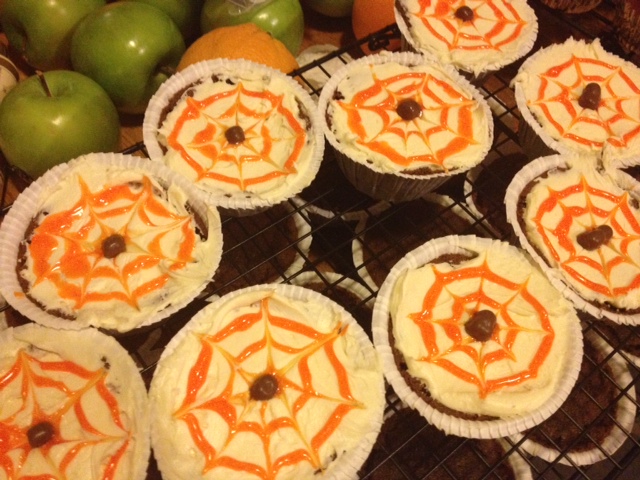
spiderweb

Chocolate cupcakes with spiderweb pattern and chocolate-licorice “spider” in the middle

The following week there was yet another training session with a different person from the same company. All very nice, well-informed people, but the most recent presenter was English. I am not sure I have written much about my increasing aural displeasure at hearing English accents (mostly due to my string of bad experiences with English people). Nothing bad about this presentation (other than listening to the accent – haha). With time, the effect softened, and it did not bother me much, although the word choice and little language fumbles (seemingly due to nerves in the beginning of the presentation) had me chuckling a bit, from the statement, “Now we can get sort of really dirty with it” (meaning we were going to get our hands dirty digging deeper into the data in the system we were learning), to his added syllables to words with which his tongue apparently struggled, making “fruition” come out as “fruitition” and three attempts at “validity”, which eventually came out as “valididity”. More vexing was the misuse of comparatives (the repeated “more deeper”, “more easier”, “more stricter”). Infuriating that a native English speaker and professional (who makes a living at this public presentation thing) would so casually and easily make these kinds of mistakes. For what reason do comparatives like “deeper”, “better”, simpler” exist than to forgo the “more” in front? On the other hand, he used the word “livery”, which is not something you hear every day.

Not long thereafter, we had a divisional webinar in which loads of people, mostly non-native English speakers, had to deliver presentations to a room full of people and to cameras set up for the webinar, broadcast to a bunch of our global offices (internal information sharing, essentially). What I noticed is that people who are quite confident giving presentations even in a large room full of people suddenly seemed quite nervous when they were placed in front of a camera. Not sure why – I suspect I am the opposite because a room full of people can ask immediate questions and put you on the spot while a camera is totally anonymous – I don’t know or care who is on the other side (well, I do know and do care, but in the immediate moment, I can’t interact with or see them, so it’s somewhat “out of sight, out of mind”).

Not really important but observations nonetheless.

Perhaps even more important is the recipe for the cupcakes.

Basic chocolate cupcake recipe

2 cups sugar

1/2 cup vegetable shortening

2 eggs

1/2 cup unsweetened cocoa

1/2 cup boiling water

2 cups flour

1 teaspoon baking soda

1 cup milk

1 teaspoon vanilla

Preheat oven to 350F/175C. Line cupcake pans with cupcake papers.

Cream sugar, shortening and eggs until fluffy. In a separate bowl, mix the boiling water with cocoa, set aside and let cool. In another bowl, sift the flour and baking soda. Once the cocoa mixture is cool, add the milk to it. Add flour mixture alternately with the cocoa-milk mixture into the creamed sugar-butter. Add vanilla. Distribute the batter evenly among the cupcake pans (to about half-full). Should make 24 cupcakes. Bake for about 20 or 25 minutes until a toothpick inserted in the center of the cupcake comes out clean.

Your favorite chocolate frosting should top these cakes when they are cool… eat them plain or decorate as desired. In this case, as evidenced above, I topped some with some small sugar decorations. I topped the others with a spiderweb design using some orange gel frosting pens and a small chocolate-covered licorice bit (as a “spider”).

Linguistic tipping points – Double down bust

Standard

I hate the term “tipping point”, but it is everywhere.

Years and years ago, when I sometimes went to a local casino, one of the blackjack dealers, an older guy named “Ted”, liked to say, in a gravelly voice, almost unintelligibly, “Double down bust.”

I have noticed, particularly during the US presidential campaigns that are overwhelming international media at the moment, that there is an unfortunate spike in the use of the term “double down”. This gambling term, which means to double one’s bet or risk, has enjoyed much greater mainstream application as candidate Mitt Romney has flip-flopped on his positions but has often “doubled down” on factually inaccurate information. The use of this term has spread throughout the media, though, and I rarely hear a news story now that is not putting this expression into play.

Needless to say, I don’t like it – especially because everyone is using it. If it were just one guy’s (or one network’s) signature phrase, it might not bother me this way. There is no controlling the way expressions and language spread like wildfire, but certain expressions just do nothing for me.

(I won’t even get into the naming of the dubious KFC Double Down sandwich (“the bun” being replaced by two slabs of chicken), which strikes me as doubling down on clogged arteries.)

Technical difficulties and language questions

Standard

Under the wire, I finished my school paper and since then, there has been a technological meltdown. Okay, I exaggerate. I just had a full day fighting against internet disconnectivity chez moi. That’s really one of the most frustrating “first-world” problems I can encounter.

In my academic readings, I found that the writers used the term “unpacking” too many times for my liking. Rarely have I seen so many texts referring specifically to “unpacking” the meaning of things. It annoyed me. Then, annoyed thoroughly, I used “unpacking” myself in my own hastily penned paper.

Today my mother said “we visited with her…”, and I realized that it is not very often that I hear the term “visit with” someone in the sense that means to “talk with”. “Visit” generally connotes that you have gone somewhere to see someone. But in this sense, “visit with” is basically just having a conversation with someone. I have been hearing my mother say this all my life, so it never struck me as odd, but when she said it today, it suddenly sounded strange. I don’t recall hearing very many other people use it this way.

I heard someone say “eighth” today, and it also annoyed me a bit just because the pronunciation can vary. I like “eighth” pronounced with a hard “T” (eighT-th) but many people pronounce it as “eigh-th”, and this always throws me. Neither way is wrong. I just do not like the latter pronunciation.

End of yet another rant.

Will I bake this week? I don’t think so.